Keynote Speech Information - Rahim Rahmani
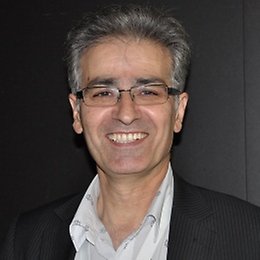
- Professor at STOCKHOLM UNIVERSITY
Biography: Currently, he is the program director of the master's program on Master's Programme
in Computer and Systems Sciences, he is responsible and examinator for the Internet of Things, Design
for Complex and Dynamic Contexts and Network Security in the master's program, and Computer architecture
in the bachelor's program. He has been responsible for the following Ph.D. courses: IoT Models and
Application and Distributed Data Processing with a focus on Distributed Ledger Technology. He is an
examiner of bachelor and master theses at the department.
Currently his research focuses on Distributed Systems, Distributed Data Processing in Distributed IoT,
Distributed Intelligence, Cognitive Edge Continuum, Tactile Internet, and large-scale decentralized
systems (Blockchain), Decentralization and Spatial Computing for Real Metaverse, AI for Edge, Pervasive
computing and Adversarial machine learning.
Title: From Spikes to Quantum Decisions (Neuroscience Inspired Edge Intelligence for Autonomous Systems and Predictive Healthcare)
Abstract: Artificial intelligence increasingly requires decisions to be made close to people, sensors, and autonomous machines.
This keynote presents a unified vision combining neuromorphic edge computing, quantum optimization, and neuroscience-inspired predictive intelligence.
NEMESIS-Edge and SpikeFusion-X enable energy-efficient multimodal perception by integrating heterogeneous sensor data directly in the spike domain.
The approach supports real-time UAV and healthcare applications while reducing latency and energy consumption under constrained resources.
A Neuromorphic-Edge-Quantum framework selectively invokes quantum optimization for complex scheduling, routing, and resource-allocation problems.
LoihiQ-Swarm extends this approach to autonomous UAV swarms by using neuron dynamics to guide distributed coordination and computational-resource selection.
Artificial Vestibular Intelligence combines wearable sensing, neuromorphic processing, Digital Vestibular Twins, and adaptive learning for predictive mobility healthcare.
Together, these frameworks enable systems that perceive sparse events, estimate evolving states, coordinate distributed agents, and act proactively.
The keynote outlines a research agenda for trustworthy, energy-efficient, privacy-preserving, and adaptive intelligence across autonomous and healthcare systems.
Time: November 20, 2026 (Keynote Session III)